

"I immigrated to Australia with nothing but a camera because I believed that camera would document truth. I ended recognising that truth might not exist to capture, that intentions get obscured by borrowed memes, that the dirty mirror was always dirty and pretending otherwise was the lie."
Bricolage Polaroid camera built around salvaged Instax Mini 40 body with exposed dual LED flash system and visible hardware throughout. Where discrete cameras let photographer and subjects maintain fiction of capturing authenticity, this device's visible strangeness destroys pretence. Subjects must consciously negotiate with its presence, performing their awareness of performing. Both operator and object function as provocateurs.
The photography industry promised smaller, quieter, faster cameras to finally "capture authentic moments." But what if there were no authentic moments to capture? Only ongoing performances using borrowed memes to express intentions that get obscured by available language.
THE DIRTY MIRROR
Camera-carrying began at 17—not hobby but necessity. Immigration to Australia with backpack essentials: clothes, toiletries, camera. The camera came because it was essential—how I documented the crossing, processed transformation, held onto what mattered.
For years shot thousands of street photographs with Ricoh GR3—discrete, nearly invisible. Moriyama's approach: capture people unaware, get close to reality. Believed I was finally capturing authentic moments because subjects didn't know I was shooting them. Most images taken in Newtown's King Street, believing I was documenting reality.
Testing this apparatus in Newtown—Sydney's "alternative hub" where "real people" supposedly express their "true selves"—recognition crystallised: I wasn't capturing authentic moments. I was photographing people performing characters borrowed from mass media catalogues. 1970s punks, 1990s goths, British mods, Ivy League types—all theatre.
Not because they were fake, but because they were expressing intentions through memes. Someone wants to express alienation, wears goth aesthetic, but now expresses "goth" (media package) rather than their specific feeling. The meme obscures the intention. Like trying to say "I love you" with Hallmark card—feeling real, borrowed language distorts into generic sentiment.
During construction, vacuuming and mopping whilst singing Smashing Pumpkins on loop: "My reflection dirty mirror / There is no connection to myself." Recognition arrived: camera as dirty mirror unable to capture reality.
"Both discrete Ricoh GR3 and visible Provocature photograph from same dirty mirror. Difference isn't result—it's honesty about what's being captured."
PERFORMANCE IS THE TRUTH
Recognition crystallised: My aesthetic choices (utilitarian clothes, "honest materials," maker culture) were also memes borrowed from Rams and Japanese craft. Whole "photographer documenting reality" identity was itself performance. Gonzo situation became inescapable—couldn't observe from outside because I was part of it.
The apparatus measures what might be photography's central inversion: the industry sold progressively quieter shutters, faster autofocus, smaller bodies—each generation claiming "now you can capture authentic moments." But what if there were no authentic moments to capture?
Through dual flash modes (clear white light vs red light), the camera generates evidence: where discrete cameras let subjects pretend authenticity might be photographed, visible strangeness forces conscious negotiation with performance. Red light makes pretence impossible. Every ND filter deployment makes apparatus intervention visible—no transparency pretence remains.
Baudrillard described this theoretically—simulation precedes reality, map before territory, hyperreal replacing real. Building this camera made his diagnosis experiential. Subjects appear to be performing before any camera appears, not because they're fake but because they're human. They might have real intentions (alienation, appreciation, rebellion) but only meme-language available for expression (goth aesthetic, varsity jacket, punk gear). The memes could obscure what they meant to say.
Father's voice returned: "La otra cara de la moneda" (the other side of the coin). Both discrete GR3 and this visible apparatus photograph from same dirty mirror. Difference isn't result—it's honesty about what's being captured.
I asked myself: "What will my portrait be—my real naked portrait?" Maybe the answer is the camera itself—weird, visible, built from borrowed parts and borrowed ideas, functional despite being cobbled together. Maybe that's the only honest portrait possible: construction made visible, borrowed materials assembled into something that works, meaning built from borrowed language that can never quite say what I mean.
Arc completes without resolution: cornered acceptance that continuation happens through borrowed materials, borrowed language, perpetual performance. What the fuck else is there? Pragmatic acceptance of perpetual negotiation. Continue anyway.
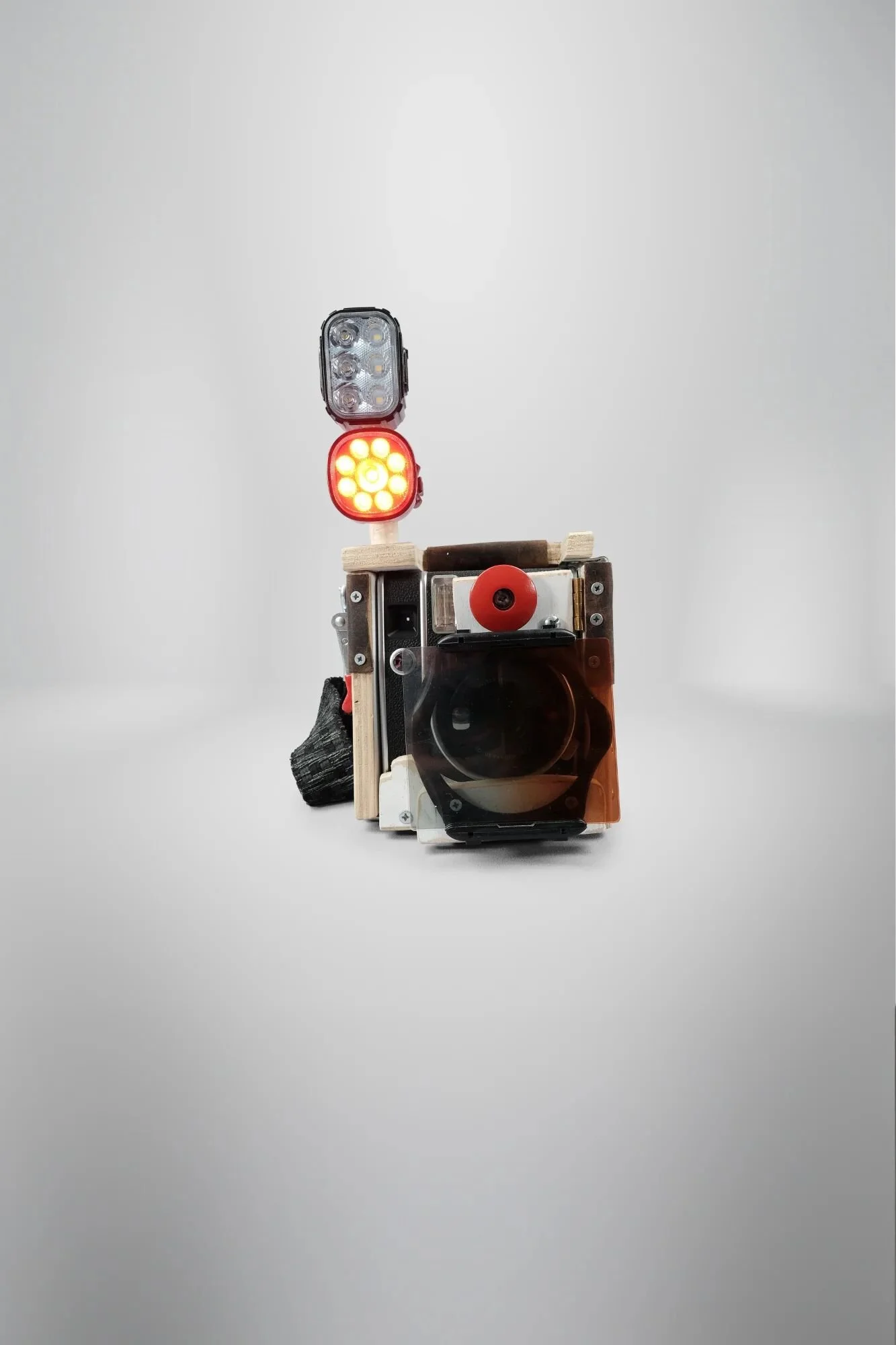
Red LED flash activated—the mode that makes performance pretence impossible. Where discrete cameras let subjects pretend authenticity might be photographed, this visible intervention forces conscious negotiation with the act of being captured. Clear white light lets subjects maintain the fiction; red light destroys it completely
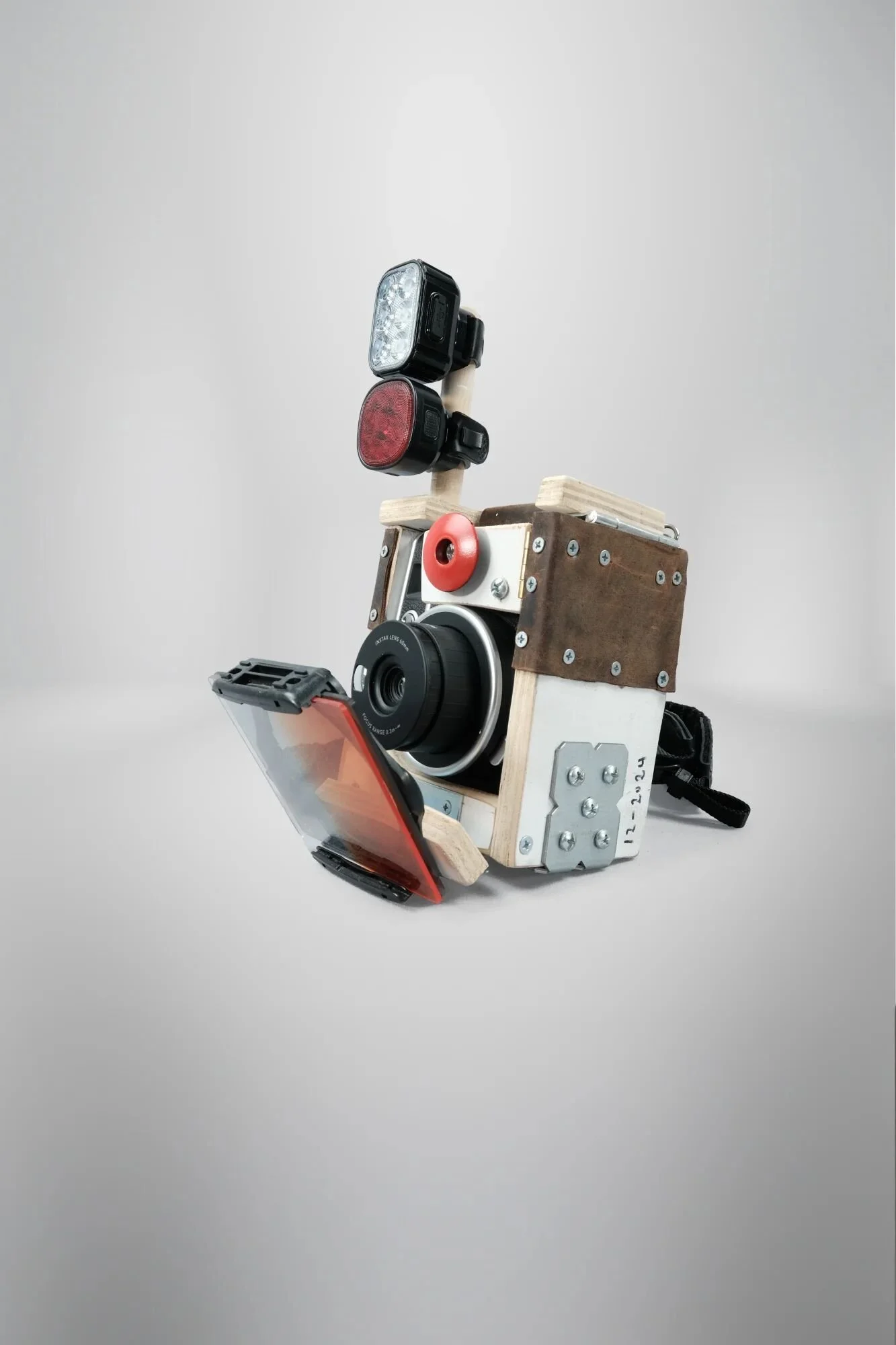
Bricolage Polaroid camera built around salvaged Fujifilm Instax Mini 40 body. Dual LED bike lights mounted on wooden rods, plywood housing with toggle clamp, ND filter mechanism, all hardware visible. The visible strangeness functions as provocation—subjects must consciously perform their awareness of performing. Both operator and object provoke honest negotiation
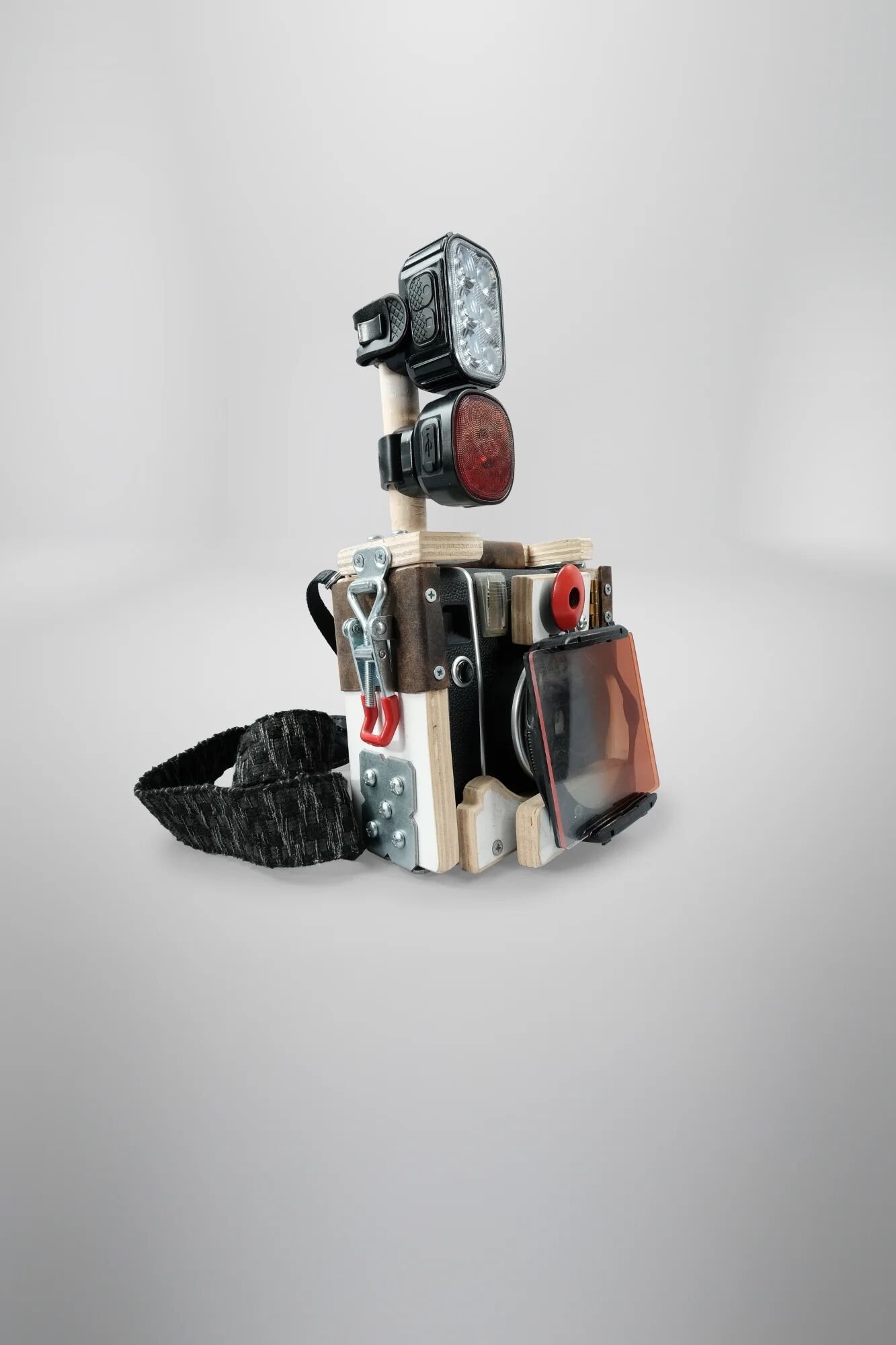
Dual LED bike light flash system mounted on wooden rods—clear white light (top) and red light (bottom). Where white LED lets subjects pretend strange camera might capture 'reality,' red light makes performance pretence impossible. ND filter visible on left side, toggle clamp with red handle on front. Complete bricolage construction showing all borrowed parts assembled into functional apparatus
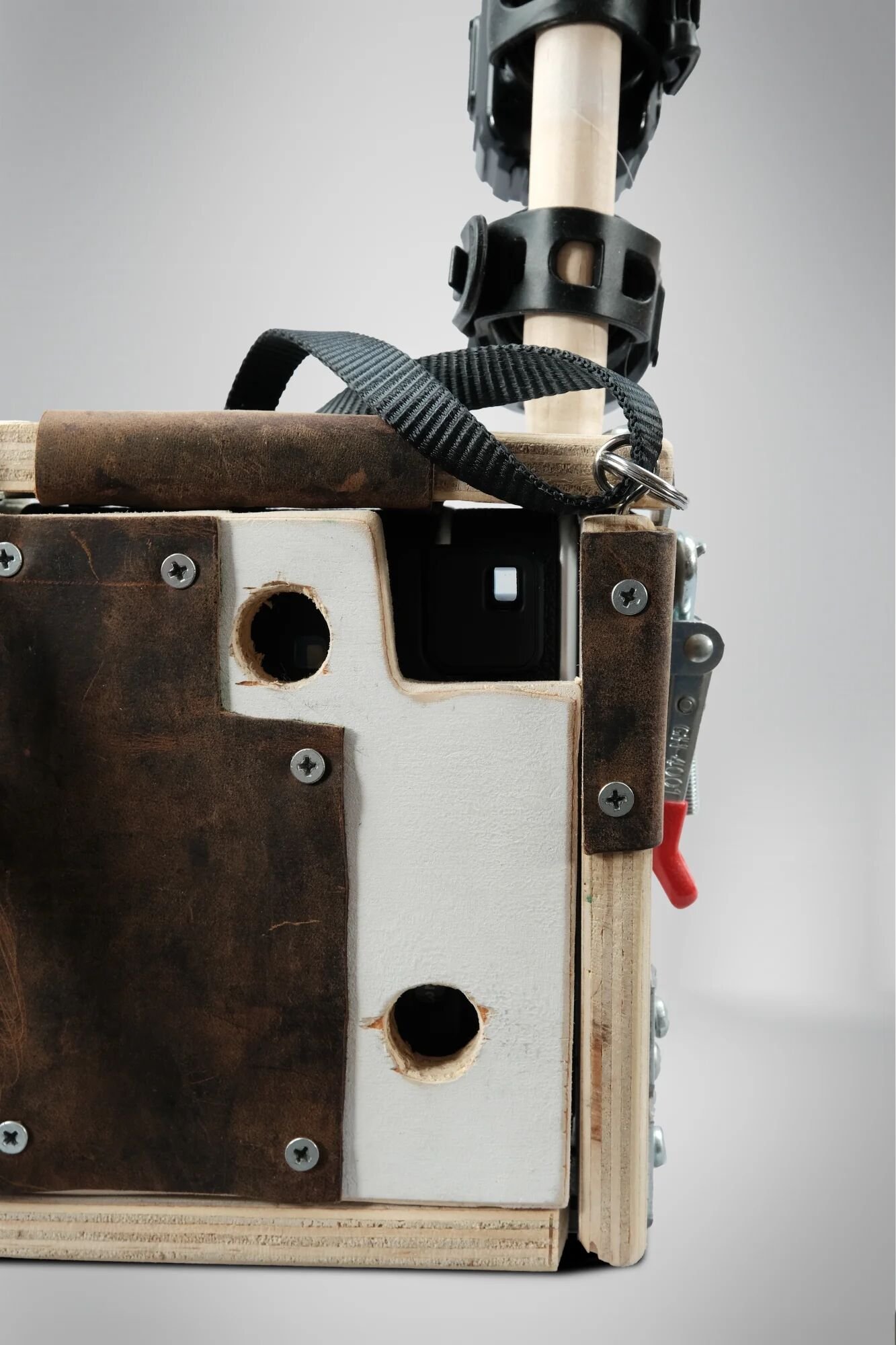
Back housing showing viewfinder holes enabling sight through camera whilst enclosed. Circular cutouts position film counter visibility, vertical spacing ensures instant photo ejects from top. Functional access designed into bricolage housing—precise holes cut for critical functions, honest construction legible throughout
Materials: Salvaged Fujifilm Instax Mini 40, plywood housing, dual LED bike lights, hinged ND filter mount, wooden rods, toggle clamp
Dimensions: 25cm height × 15cm length × 11cm width, handheld bricolage construction
Bricolage Housing: Plywood construction allows access to critical functions. Precise viewfinder hole enables sight through camera whilst enclosed. Wood opening positions film counter visibility. Vertical spacing ensures instant photo ejects from top. Toggle clamp provides quick case opening. Uses standard tripod mount only.
Dual Flash System: Cut opening in plywood housing for built-in flash. Mounted LED bike lights on wooden rods for additional lighting—manually triggered. Dual modes create performance conditions: clear white lets subjects pretend strange camera might capture "reality," red light makes pretence impossible. Every flash deployment makes apparatus intervention visible—no transparency pretence remains.
ND Filter Mechanism: Fabricated hinged screw-mount mechanism for ND filter deployment. Filter swings in/out of light path. Handheld-capable despite added weight, no light leaks, fully operational.
Core Recognition: I asked myself "What will my portrait be—my real naked portrait?" Maybe the answer is the camera itself—weird, visible, built from borrowed parts and borrowed ideas, functional despite being cobbled together. Maybe that's the only honest portrait possible: construction made visible, borrowed materials assembled into something that works, meaning built from borrowed language that can never quite say what I mean.
Billy Corgan's Dirty Mirror: "My reflection dirty mirror / There is no connection to myself." Both discrete GR3 and visible Provocature photograph from same dirty mirror. Difference isn't result—it's honesty about what's being captured. Camera as dirty mirror unable to capture reality—meaning obscured by memes, by performative identity construction.
Status: Fully operational. Primary function complete: philosophical recognition that performance might be the truth, borrowed language might be how we speak, dirty mirror might have been always dirty. Secondary use continuing: honest documentation tool admitting what it cannot do—capture some essential truth underneath the performance. Arc completes without resolution. Continue anyway.
Context in Series
inal piece (#12 of 12), completing Cornered Optimism arc. Following Last Brew's test of whether principles survive when vision fails, confronts fundamental recognition: perhaps performance IS the truth, borrowed language might be how we speak, intentions get obscured by available memes.
Both discrete GR3 and visible Provocature photograph from same dirty mirror—difference isn't result but honesty about what's captured. Immigration with camera believing it would document truth ends recognising truth might not exist to capture.
Arc completes without resolution: cornered acceptance that continuation happens through borrowed materials, borrowed language, perpetual performance. Not because we're fake but because we're human—real intentions (alienation, appreciation, rebellion) expressed through meme-language (goth aesthetic, varsity jacket, punk gear) that obscures what we meant to say.
"What the fuck else is there?" Pragmatic acceptance of perpetual negotiation. Continue anyway.