
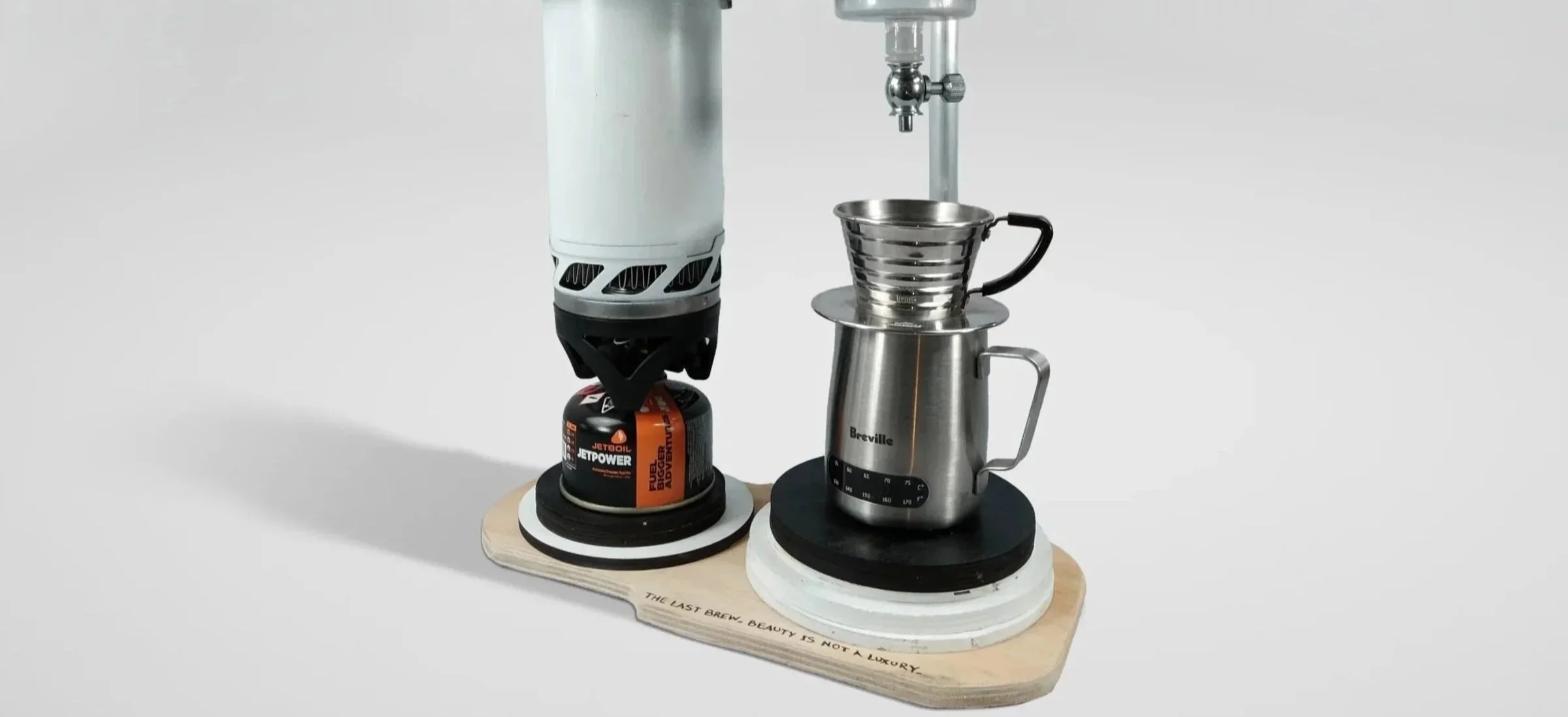
"My Moccamaster still works. Grid's still up. Built this anyway—not preparing for collapse, but because Rams' principles kept bothering me under imagined scarcity."
Wooden reconstruction of Dieter Rams' KF20 Aeromaster coffee maker built from salvaged timber and modified camping equipment. Actually brews coffee. Laminated laser-cut wood cylinder houses stainless steel and borosilicate glass dripper, hand-cut frame maintains KF20's functionally derived proportions, modified Jetboil Zip provides heat. Proportions work in wood as they worked in plastic.
First laser-cutting project, first lamination work. Rams' modernist future never materialised—planned obsolescence hidden behind minimalist surfaces, climate collapse, sealed unrepairable products. Utopian vision inverted completely. But what about principles themselves?
TRENCH ART LINEAGE
During inscription—pressing ballpoint pen into wood repeatedly for 45 minutes etching "THE LAST BREW. BEAUTY IS NOT A LUXURY"—childhood memory surfaced.
My father's studio in Paraguay. Decorated artillery shell on shelf, brass casing engraved with star and script. Soldier carved it for his madrina de guerra during war, transformed explosive casing into gift through patient repetition with whatever sharp tool he had.
My hands chose identical method: no wood-burning equipment, no laser. Ballpoint pen pressed repeatedly, tracing same lines until depth accumulated. Not coincidence. Lineage. That shell transmitted method across decades: beauty doesn't require specialised tools, requires patience applied to whatever you have.
Recognition crystallised: I've been running trench art methodology my entire practice without naming it. Not conditions—soldier faced mortal threat, I choose constraints. But structure: transformation of violence/waste into beauty, precision under constraint, building for meaning whilst geographically separated from origin.
My workshop beside Erskineville railway corridor is my trench—literally, an actual trench running alongside the tracks. WhatsApp messages to my mother in Paraguay—my madrina de guerra. The carved shell planted something as child. Building this, hands remembered. Lineage proved real.
"When you can't waste material, Rams' principles aren't aesthetic luxuries—they're structural necessities. Balanced proportions create stability with minimum material. Visible joints make repair legible. Honest construction uses less energy than deception."
PRINCIPLES SURVIVE, VISION FAILS
Compulsion built around circular question: Rams' ten principles assumed mass production, democratic access, social progress through rational aesthetics. That modernist future never materialised. But do principles survive translation when materials become constrained?
Recognition arrived through construction: functionally derived proportions work better when you can't waste wood on decoration, can't hide poor construction behind styling. "As little design possible" becomes structural truth, not aesthetic choice.
Circular pattern emerges: Discipline (Rams' 1960s principles) → Corruption (abundance enabling decoration) → Necessity (constraint returning to truth). Principles work at both ends but fail where undisciplined abundance enables waste.
Trench art methodology operates identically: WWI soldiers carved spent shell casings under actual survival conditions. Zero survival value. Made anyway. That behaviour proves human capacity to preserve aesthetic care under genuine threat. This tests whether design principles themselves survive when materials become constrained whilst methods transmit across geographic separation.
Rams believed good design could create better world. Building reveals separation between vision and principles—vision failed completely, principles prove universal. Geography separates, methods transmit, beauty persists through patient work despite constraint.
Workshop beside railway becomes trench. WhatsApp to Paraguay mother becomes madrina de guerra communication. Soldier's method lives in my hands. Different war, same structure. Measurement continues.
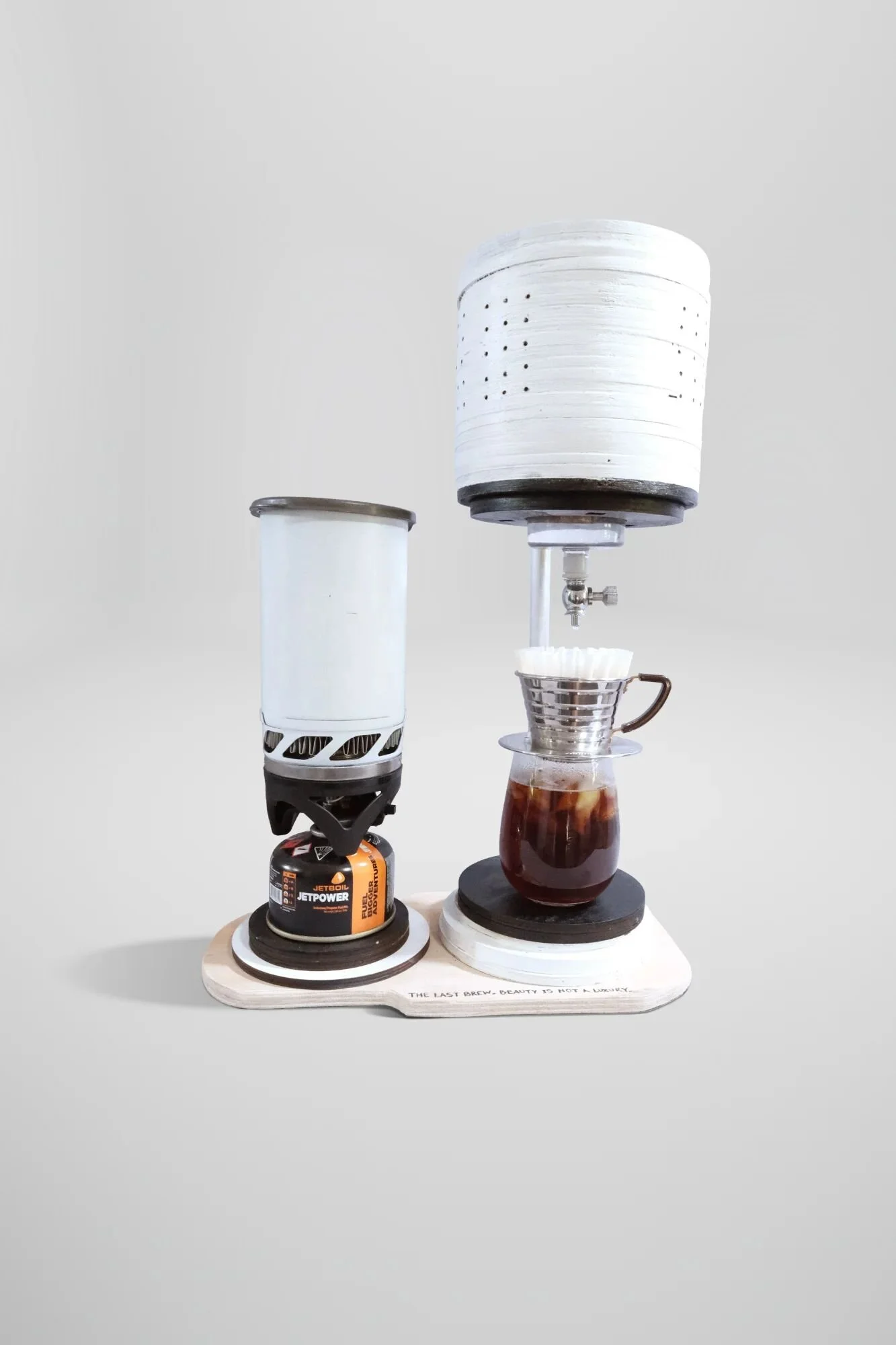
Actually brews coffee. Laminated laser-cut wood cylinder, stainless steel dripper, borosilicate glass, modified Jetboil Zip. Proportions maintain KF20 Aeromaster (1972) functional relationships through material translation. When you can't waste material, Rams' principles become structural necessities, not aesthetic luxuries
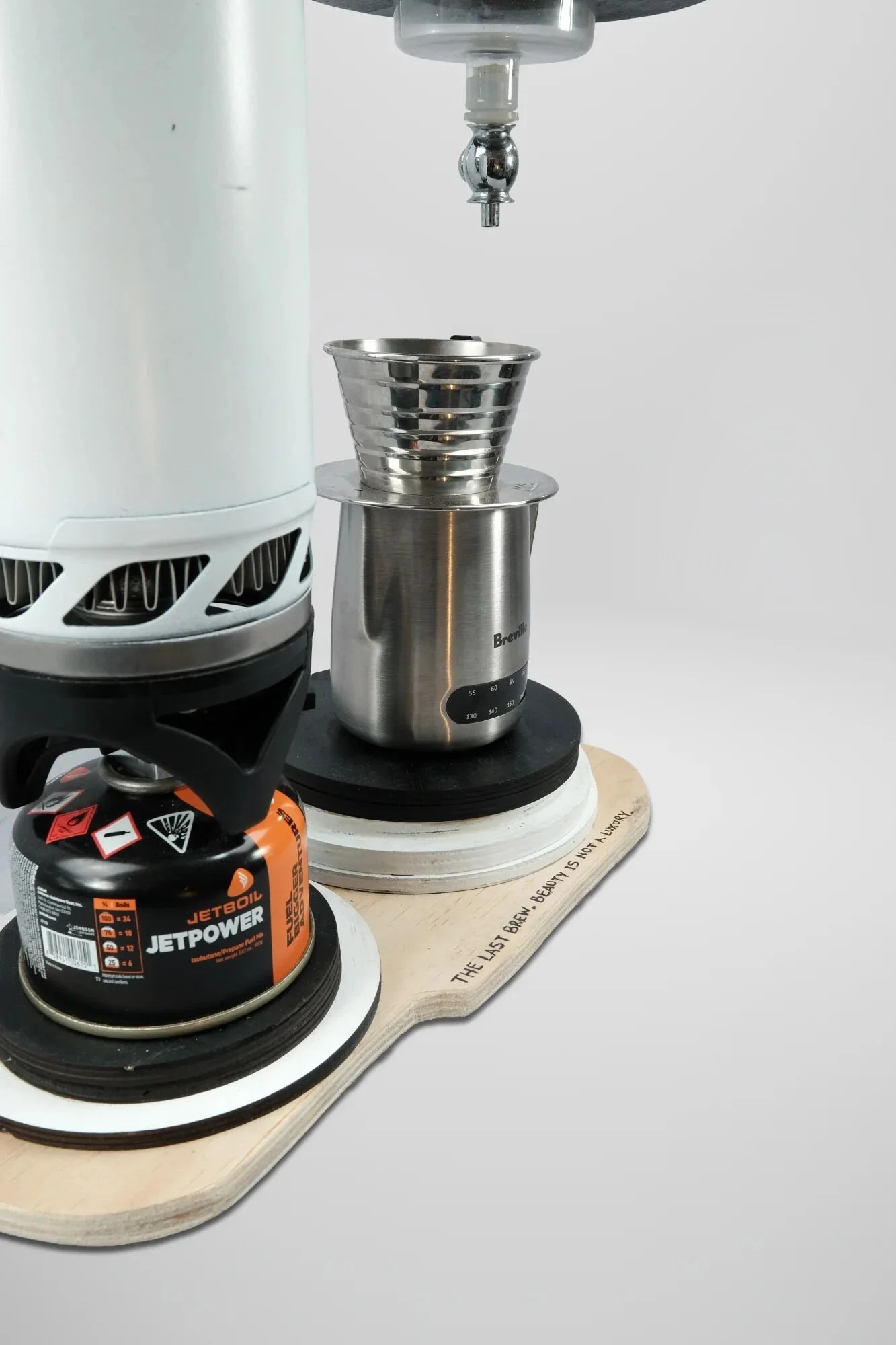
"Ballpoint pen pressed repeatedly for 45 minutes etching 'THE LAST BREW. BEAUTY IS NOT A LUXURY'—identical to soldier's method on decorated artillery shell. My father's studio in Paraguay: brass casing engraved for his madrina de guerra during war. That shell transmitted method across decades. Not coincidence. Lineage."
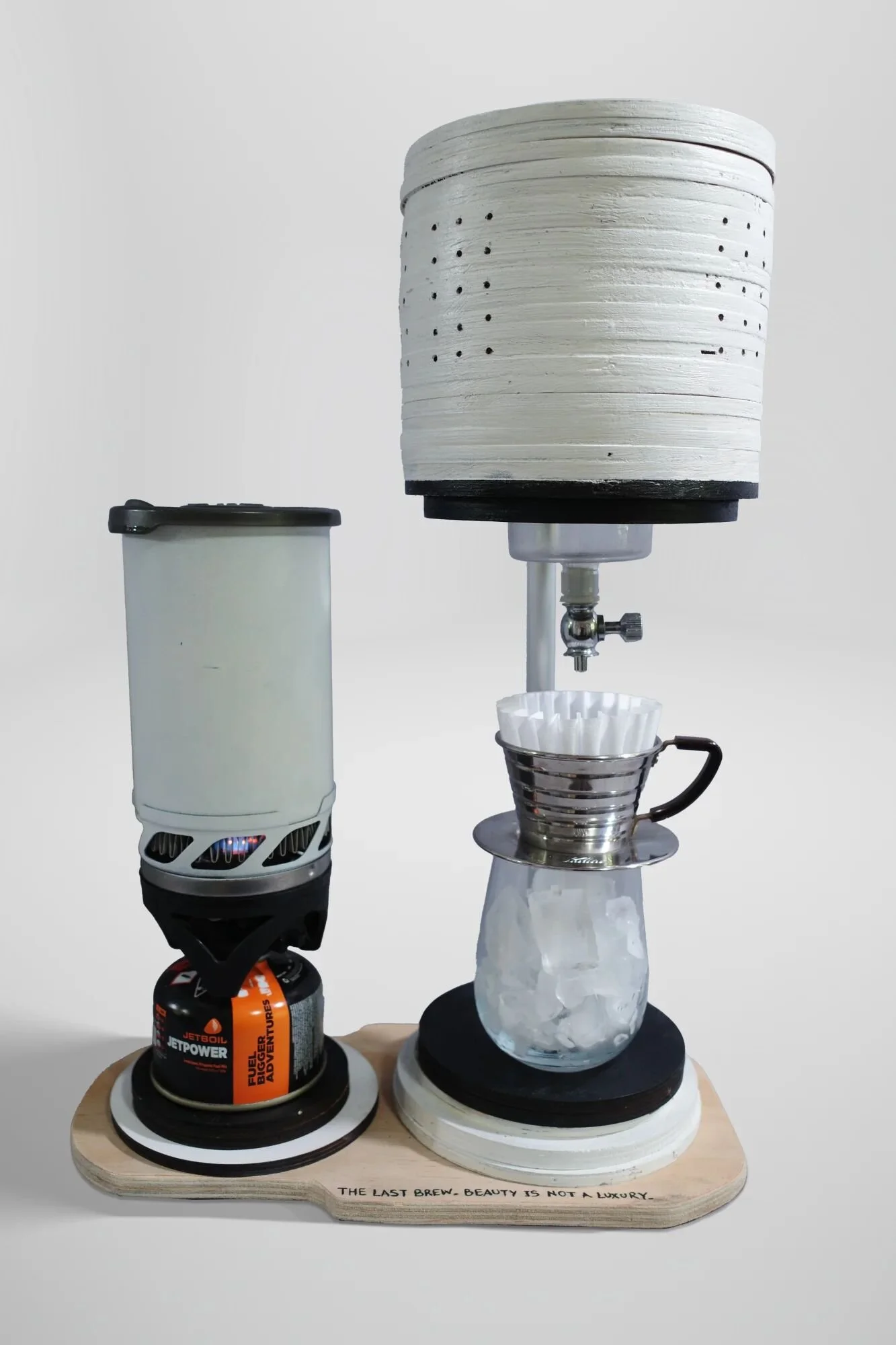
Wooden reconstruction from salvaged pine timber. First laser-cutting project, first lamination work. Rams' modernist future never materialised—planned obsolescence, climate collapse, sealed products. But principles prove universal: functionally derived proportions work better when you can't waste wood on decoration, can't hide poor construction behind styling.
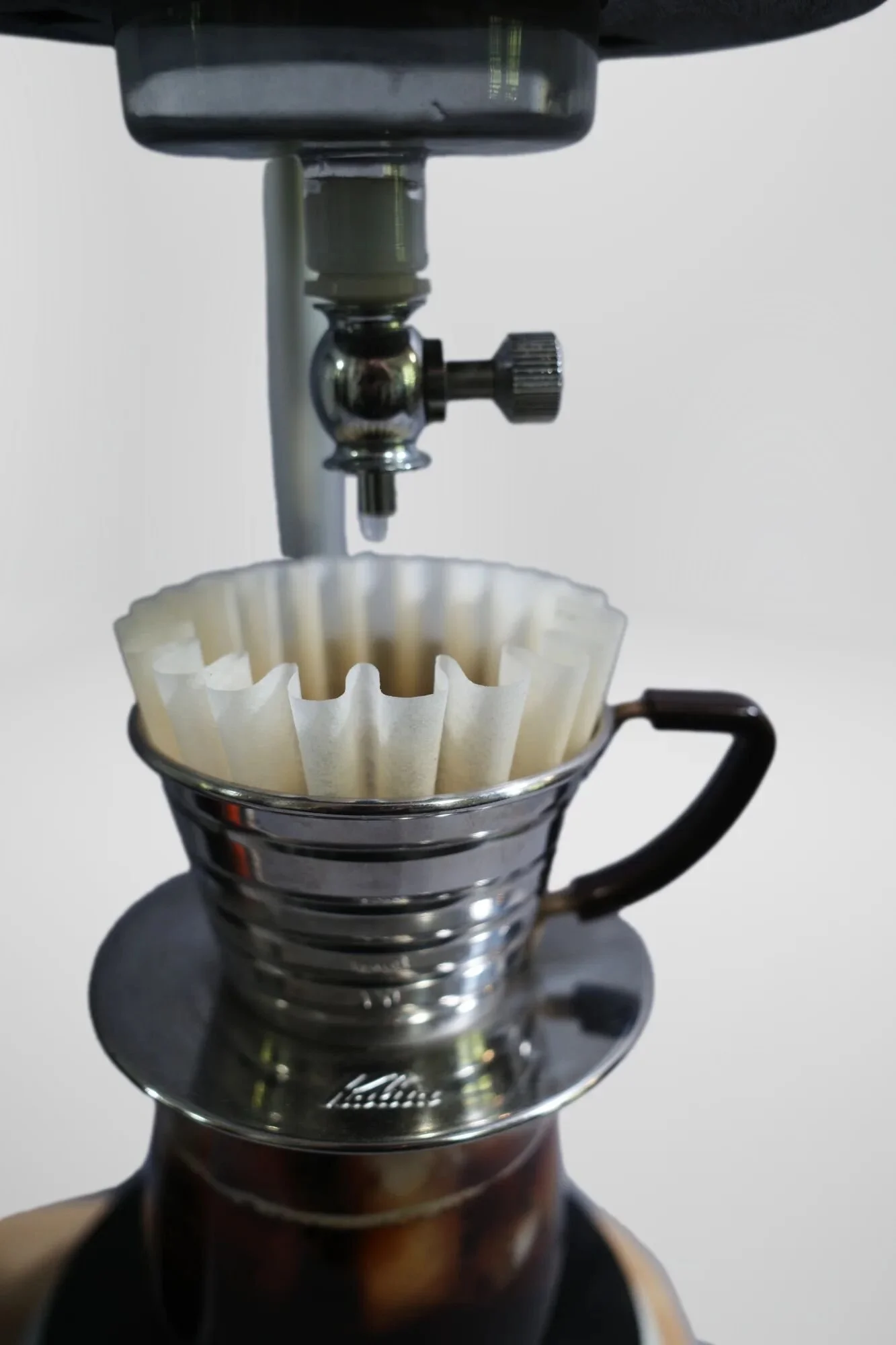
Stainless steel and borosilicate glass dripper, paper filter. Clean material separation—wood provides structure, steel/glass handles water contact and thermal shock. Modified Jetboil Zip system runs safely through complete brewing cycle, wood positioned above heat zone. Vision failed completely. Principles prove universal.
Materials: Salvaged pine timber, stainless steel dripper, borosilicate glass, modified Jetboil Zip system
Dimensions: Proportions maintain KF20 Aeromaster (1972) functional relationships
Wooden Body: Salvaged pine timber, laser-cut rings laminated and stacked creating hollow cavity. Frame hand-cut with visible joinery, all connections serviceable. Clean material separation—wood provides structure, steel/glass handles water contact and thermal shock.
Heat System: Modified Jetboil Zip system, neoprene sleeve removed exposing bare aluminium, hand-painted white matching Rams' aesthetic language. System runs safely through complete brewing cycle, wood positioned above heat zone.
Proportional Analysis: Maintains KF20's functional relationships through proportional analysis of archival photos—no physical reference available. First laser-cutting project and first lamination work. Multiple test pieces with spacing issues before achieving clean final assembly.
Hand-Etched Inscription: Ballpoint pen pressed repeatedly, 45 minutes of repetitive tracing until pressure accumulated into permanent grooves. Identical to soldier's method on decorated artillery shell. Patient repetition transforming hard material through available implements. "THE LAST BREW. BEAUTY IS NOT A LUXURY"
Trench Art Lineage: My father's studio in Paraguay—decorated artillery shell on shelf, brass casing engraved with star and script. Soldier carved it for his madrina de guerra during war. That shell transmitted method across decades. My hands chose identical method without conscious planning. Not coincidence. Lineage. Workshop beside Erskineville railway is my trench. WhatsApp messages to my mother in Paraguay—my madrina de guerra.
Status: Fully operational. Actually brews coffee, proportions proven functional through material translation. Mixed methods unified through proportional consistency. Materials honest, construction legible, Rams' visual language maintained through clear proportional relationships. Trench art methodology continues operating. Soldier's method lives in my hands. Different war, same structure. Measurement continues. Principles prove universal.
Context in Series
Eleventh piece (#11 of 12), approaching arc completion. Following Abyss Illuminator's daily orientation choices, tests whether design principles themselves survive when utopian vision fails completely.
Rams' modernist future never materialised—planned obsolescence, climate collapse, sealed products. But principles prove universal: balanced proportions create stability with minimum material, honest construction uses less energy than deception. When you can't waste material, Rams' principles become structural necessities, not aesthetic luxuries.
Ballpoint pen inscription method transmitted from soldier's carved shell across decades—lineage proved real through patient repetition. Trench art methodology: transformation of violence/waste into beauty, precision under constraint, building for meaning whilst geographically separated from origin. Workshop beside Erskineville railway becomes trench; WhatsApp messages to Paraguay mother become madrina de guerra communication. Different war, same structure.
Sets up Lens Provocature (#12) which confronts final recognition: perhaps performance IS the truth, borrowed language might be how we speak, intentions get obscured by available memes.